Christian Sites
The easiest way to find information on specific archaeological sites or historic buildings is to search Trove.scot. Trove is an official Scottish government site incorporating the National Record of the Historic Environment and the listed buildings of Scotland.
This page is to guide you to some of the most interesting Christian sites in Shetland, arranged thematically. Click on the hyperlinks to find more information.
The Papar, monks and missionaries to Shetland.
The first Christians in Shetland were probably Celtic monks in the tradition of St Columba of Iona. The earliest archaeological evidence we have of their settlement is from the 7th Century. Important sites which can still be visited are PAPIL, ST NINIAN'S ISLE, NOSS, BRESSAY and PAPA STOUR. New light on this period (7th - 9th century) has been given by the recent excavation of a Pictish monastery on the Scottish mainland at Portmahomack.
The Norse Church, 10th - 15th Centuries
Shetland was part of the Scandinavian world for some 500 years. Remains from this period can be found at ST NINIAN'S ISLE CHAPEL, FRAMGORD (Unst), LUND (Unst) and the Viking longhouses at JARLSHOF. In the Middle Ages the three principal churches were at IRELAND, PAPIL and TINGWALL. There are also places associated with ST MAGNUS of ORKNEY.
The Presbyterian Parishes and the Disruption
The Church of Scotland has recently sold off many of its churches, but for the most part the buildings of the old parish sytem remain.
The Evangelical Revival of the 19th Century and the spread of Methodism.
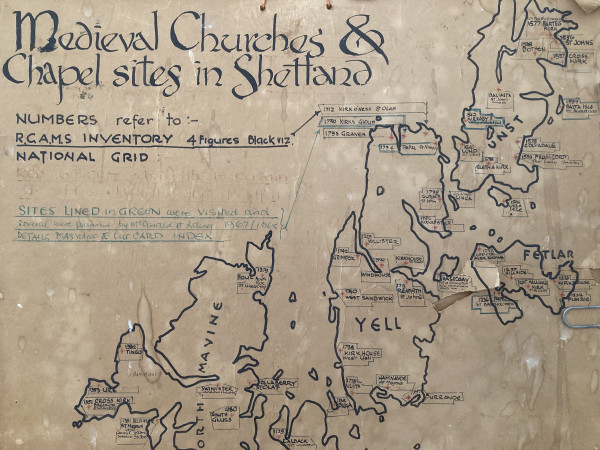
Location of the chapels.
The Catholic Church in Shetland.
Sites associated with the NORTH POLE MISSION and HERRING BOOM. ST MARGARET'S CHURCH.
The Episcopal Church in Shetland.
ST MAGNUS' CHURCH, BURRAVOE CHAPEL, the buildings of SOLI and New Monasticism at THE GLEBE.
The Orthodox Church
ST SUNNIVA'S SKETE, UNST and the COMMUNITY OF ST NINIAN.
A Secular Pilgrimage: Shetland and the Norwegian Resistance during the Second World War.
SCALLOWAY, KERGORD and LUNNA.
